
Muay Thai judges evaluate the overall fight impression rather than treating each round as a standalone contest the way boxing or MMA judges do. Body kicks and knees score highest, followed by elbows, then punches. Rounds three and four carry the most weight in traditional Thai scoring. Fighters who demonstrate balance, composure, and clean technique score more favorably than those relying on volume alone. Each bout consists of five three-minute rounds with two-minute rest periods between rounds.
Nothing frustrates a first-time Muay Thai spectator more than deciding to watch Muay Thai at Bangla Boxing Stadium without understanding the scoring system, only to see a fighter appear to dominate for three rounds before losing the decision. This happens regularly at Bangla Boxing Stadium and every other traditional venue in Thailand. The confusion stems from a scoring system that works fundamentally differently from boxing or MMA. Understanding those differences turns a bewildering evening into a deeply engaging one.
Whole-Fight Evaluation vs Round-by-Round Scoring
Boxing and MMA judges score each round as a standalone contest,winning seven of ten rounds in boxing secures the fight regardless of what happens afterward. Muay Thai judges use the same 10-point must scorecards, but those round-by-round scores serve as reference notes rather than a running total. Judges evaluate the fight as a complete picture, weighing the overall impression of dominance across all five rounds.
A fighter who narrowly edges rounds one through three can still lose if the opponent dominates rounds four and five convincingly. The margin of earlier victories matters enormously,a slight edge in round two carries far less weight than a decisive fourth round. This evaluation approach reflects traditional Thai sporting philosophy where sustained excellence and finishing strength matter more than early advantages that fade under pressure.
The practical consequence for spectators becomes clear when decision announcements seem to contradict the apparent action. A fighter who landed more total strikes but whose opponent delivered cleaner, more damaging techniques in later rounds frequently loses on the scorecards. Recognizing this pattern prevents the frustration that accompanies applying boxing logic to Muay Thai decisions.
Striking Hierarchy and Scoring Weight
Not every technique carries equal weight in Muay Thai scoring. The hierarchy follows a clear structure that rewards power, technical difficulty, and visible effect over pure volume.
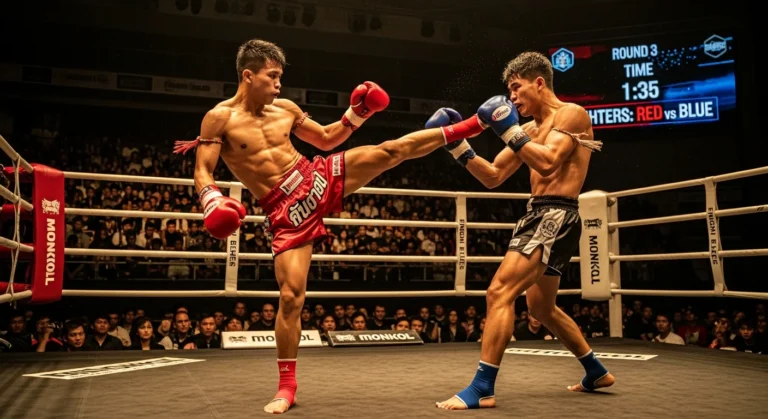
Body kicks and head kicks rank highest in the scoring hierarchy. A clean roundhouse to the ribs that visibly moves an opponent scores heavily with judges,the rotation, commitment, and impact required demonstrate technical proficiency and generate the most decisive scoring impressions. Head kicks carry even greater potential when they land cleanly, reflecting the extreme difficulty and risk involved in high-line attacks.
Knee strikes, particularly inside the clinch, represent the most respected scoring technique in traditional Thai Muay Thai. Controlling an opponent in the clinch while landing powerful knees demonstrates simultaneous dominance in grappling positioning and striking execution. Judges value this combination of control and offense highly because it reflects advanced skill integration that separates experienced fighters from beginners.
Elbows carry devastating scoring potential when they produce visible damage,cuts, swelling, or staggering effects. A well-placed elbow that opens a cut above an opponent’s eye can transform the trajectory of an entire fight, forcing the cut fighter into defensive mode while the scoring advantage compounds through subsequent rounds.
Punches score in Muay Thai but carry less weight unless they produce visible damage through knockdowns, cuts, or clear disorientation. This reality explains why experienced Thai fighters often absorb combinations of punches without apparent concern while focusing on landing fewer but heavier kicks and knees. Western boxing fans accustomed to valuing punch output sometimes struggle with this aspect of Muay Thai scoring,a fighter landing 50 jabs may score less than an opponent landing three clean body kicks.
Sweeps, where a fighter dumps an opponent to the canvas by catching a kick and tripping the support leg, score highly because they demonstrate technical superiority. The swept fighter loses points not just for the technique itself but for the perception of lost control and compromised balance. Clean sweeps that drop an opponent flat generate audible crowd reactions that telegraph scoring impact in real time.
Why Early Rounds Appear Cautious
First-time spectators at Bangla Boxing Stadium often wonder why early rounds feel measured and cautious compared to the explosive action in later rounds. Fighters exchange single techniques rather than launching sustained attacks in rounds one and two. This is not laziness or lack of fitness,it represents strategic intelligence built into the sport’s competitive DNA.
Traditional Thai scoring treats rounds one and two as exploratory periods. Neither fighter commits fully because judges assign minimal weight to early action, and the gamblers in the crowd are still establishing opening odds. Rounds three and four become the decisive battleground where fighters push hardest and judges pay the closest attention. Round five often cools down if one fighter has clearly established dominance, as both competitors protect themselves from unnecessary damage when the outcome appears decided.
This scoring rhythm also means that arriving slightly late to a fight card and missing the opening moments of early undercard bouts still allows spectators to catch peak action in the middle and later rounds of every fight. The most dramatic exchanges, decisive knockdowns, and scoring-defining moments consistently cluster in rounds three and four.
Reading the Fight Like a Local
With scoring knowledge in hand, spectators can follow the action the way experienced Thai audiences do. Key indicators reveal which fighter holds the scoring advantage at any moment during the fight.
Ring control provides the first signal,the fighter who controls the center of the ring and dictates distance generally holds positional advantage. Kick effectiveness becomes visible through impact assessment: whose kicks land cleanly on the body versus getting checked on the shin? Clean kicks that snap against the ribs produce audible impact distinguishable from partially blocked attempts. In the clinch, which fighter positions for knees versus which struggles to break free reveals grappling dominance that judges weight heavily.
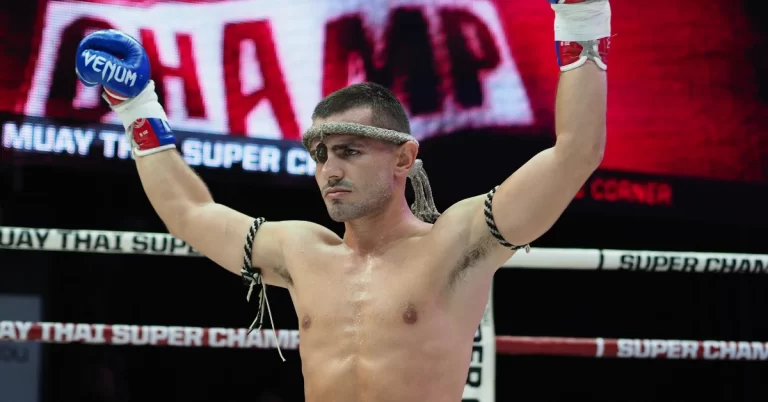
Fighters who raise their hands between rounds project confidence to judges and bettors,a communication tool as much as a celebration. A fighter who slowly answers the referee’s count after a knockdown signals vulnerability even if physically capable of continuing. Presentation matters in Muay Thai in ways that boxing fans might not expect, with composure and control contributing to scoring impressions alongside pure striking output.
Balance and composure after landing or receiving strikes influence judge evaluations subtly but significantly. Stumbling after throwing a powerful kick reduces its scoring value by suggesting compromised control. Absorbing a hard shot without visible reaction diminishes the attacker’s credit by projecting durability and defensive strength. Muay Thai rewards elegance alongside raw power, creating a sport where technical sophistication and artistic presentation coexist with devastating striking force.
Experiencing Scoring Live
Understanding the scoring system makes every fight night at Bangla Boxing Stadium more rewarding. Bangla Boxing Stadium behind Jungceylon presents eight professional bouts every evening, seven nights a week, at 9:00 PM with both male and female fighters. Wednesday and Saturday evenings showcase MMA formats alongside traditional Muay Thai, where different scoring criteria apply under unified MMA rules. The covered, well-ventilated stadium keeps attention on the ring for focused fight observation. Stadium tickets cost 1,500 THB and ringside 1,900 THB, with all ticket categories including a complimentary t-shirt.
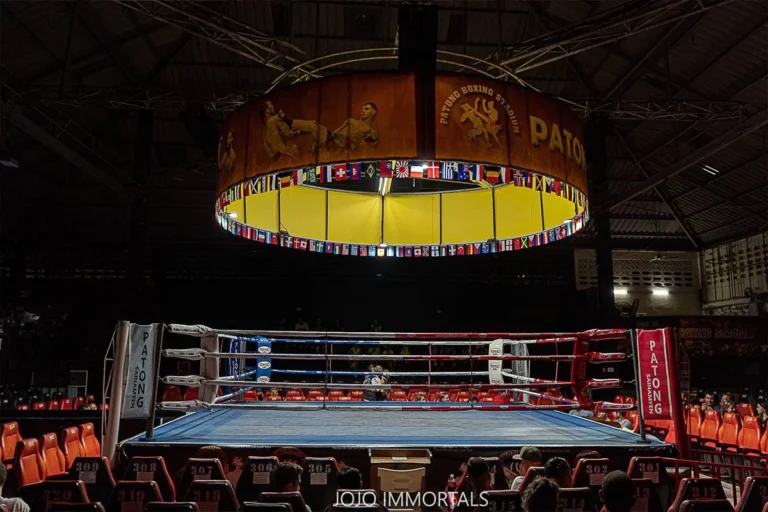
The Phuket stadium guide compares both venues in detail. Patong Boxing Stadium on Sainamyen Road hosts eight professional Muay Thai bouts Monday through Saturday evenings at 9:00 PM, with stadium tickets starting at 1,500 THB and ringside at 1,800 THB.
Sources and further reading:
- Wikipedia, Muay Thai: en.wikipedia.org
- World Muay Thai Council, Rules: wmcmuaythai.org
- IFMA, Muay Thai Rules & Regulations: muaythai.sport